HSAs in 2026: Maximizing Your Tax-Advantaged Savings

Anúncios
Health Savings Accounts (HSAs) in 2026 offer a triple tax advantage for eligible individuals, allowing tax-deductible contributions, tax-free growth, and tax-free withdrawals for qualified medical expenses, making them powerful tools for healthcare and retirement planning.
Anúncios
Navigating personal finance can often feel like a complex puzzle, especially when it comes to healthcare costs and future planning. In this landscape, understanding how to leverage Health Savings Accounts (HSAs) in 2026: Maximizing Your Personal Tax-Advantaged Savings becomes not just beneficial, but essential. This comprehensive guide will explore the intricacies of HSAs, offering insights and strategies to optimize your financial well-being for years to come.
Understanding health savings accounts: The basics for 2026
Anúncios
Health Savings Accounts, commonly known as HSAs, are powerful financial tools designed to help individuals save for healthcare expenses on a tax-advantaged basis. For 2026, the fundamental principles remain consistent, offering a unique blend of tax benefits that can significantly impact your financial future.
Eligibility for an HSA is tied to enrollment in a High-Deductible Health Plan (HDHP). These plans typically feature lower monthly premiums but require individuals to pay more out-of-pocket before insurance coverage kicks in. This structure makes HSAs a crucial component for managing healthcare costs effectively. The funds contributed to an HSA are not only tax-deductible but also grow tax-free, and qualified withdrawals are also tax-free, creating a ‘triple tax advantage’ that few other investment vehicles offer.
Eligibility requirements for HDHPs
To be eligible for an HSA in 2026, you must be covered under an HDHP and not be enrolled in Medicare, nor be claimed as a dependent on someone else’s tax return. The IRS defines specific deductible and out-of-pocket maximums for HDHPs each year. These thresholds are critical for determining HSA eligibility.
- Minimum Deductible: For 2026, the minimum deductible for an HDHP will likely see adjustments from previous years, impacting initial out-of-pocket costs.
- Maximum Out-of-Pocket: There are also limits on the total out-of-pocket expenses for HDHPs, including deductibles, co-payments, and co-insurance, but not premiums.
- Other Health Coverage: You generally cannot have any other health coverage besides your HDHP, with some exceptions like vision, dental, or specific disease insurance.
Understanding these basic requirements is the first step toward unlocking the full potential of an HSA. The flexibility and long-term growth potential make it a cornerstone of smart personal finance, especially when planning for unpredictable medical expenses or future retirement healthcare needs.
In essence, HSAs provide a strategic avenue for individuals to take greater control over their healthcare finances. By meeting the eligibility criteria and understanding the fundamental structure, you can begin to harness the significant tax advantages offered in 2026, paving the way for more secure health and financial planning.
Contribution limits and strategies for 2026
Maximizing your HSA in 2026 begins with understanding the updated contribution limits and implementing effective strategies to reach them. The IRS typically adjusts these limits annually to account for inflation, making it crucial to stay informed to optimize your savings.
For 2026, we anticipate further increases in the individual and family contribution limits, alongside the catch-up contribution for those aged 55 and over. These limits represent the maximum amount you can contribute to your HSA each year, and contributing the full amount is often a recommended strategy to fully leverage the tax benefits.
Navigating contribution limits
The IRS sets specific limits for annual HSA contributions. Exceeding these limits can result in penalties, so accurate tracking is essential. These limits are typically higher for those with family HDHP coverage compared to individual coverage.
- Individual Coverage Limit: The maximum amount an individual can contribute to their HSA for 2026.
- Family Coverage Limit: The maximum amount for those covered under a family HDHP plan, significantly higher than individual limits.
- Catch-Up Contributions: Individuals aged 55 and older can contribute an additional amount annually, a valuable benefit for those nearing retirement.
Beyond simply contributing, strategic approaches can enhance your HSA’s value. Consider setting up automatic contributions from your paycheck if your employer offers it, or regular transfers from your bank account. This ‘set it and forget it’ method ensures consistent saving and helps you reach the maximum contribution without actively thinking about it each month.
Another powerful strategy is to pay for current medical expenses out-of-pocket, if feasible, and allow your HSA funds to grow untouched. Since there’s no ‘use it or lose it’ rule with HSAs, these funds can continue to accumulate and be invested, potentially growing into a substantial nest egg for future healthcare costs in retirement.
Effectively managing your contributions and understanding the limits is fundamental to maximizing your HSA’s potential. By proactively planning and consistently contributing, you position yourself to take full advantage of the unique tax benefits and long-term growth opportunities that HSAs provide in 2026.
The triple tax advantage: Unpacking its power
The allure of Health Savings Accounts primarily stems from what is often referred to as the ‘triple tax advantage.’ This unique combination of tax benefits makes HSAs one of the most powerful savings and investment vehicles available for healthcare expenses and retirement planning.
Understanding each component of this triple advantage is key to appreciating the long-term financial impact an HSA can have. It’s not just about saving money; it’s about optimizing how that money grows and is eventually used, all while minimizing your tax burden.
Breaking down the tax benefits
The three pillars of the HSA tax advantage work synergistically to create a highly efficient savings mechanism. Each one offers significant financial relief at different stages of the HSA lifecycle.
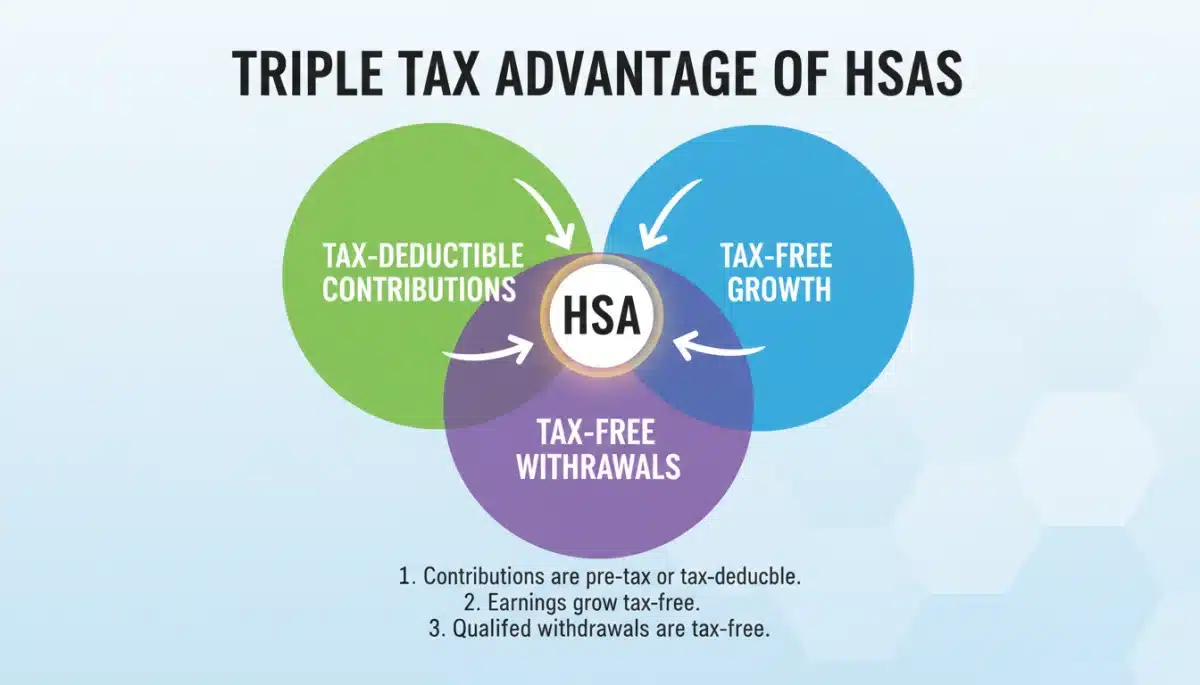
- Tax-Deductible Contributions: Money you contribute to your HSA is tax-deductible, meaning it reduces your taxable income for the year, regardless of whether you itemize deductions. This is an immediate tax saving.
- Tax-Free Growth: Any earnings from investments within your HSA grow tax-free. Unlike a traditional brokerage account where investment gains are taxed annually, your HSA funds compound without being eroded by taxes, leading to potentially significant growth over time.
- Tax-Free Withdrawals: When you withdraw funds from your HSA to pay for qualified medical expenses, those withdrawals are completely tax-free. This benefit extends to a wide range of medical costs, from doctor’s visits and prescriptions to dental and vision care.
This triple tax benefit distinguishes HSAs from other savings accounts, offering unparalleled flexibility and financial leverage. Imagine contributing pre-tax dollars, watching them grow without a capital gains tax burden, and then withdrawing them tax-free for essential medical needs – it’s a financial trifecta.
The power of the triple tax advantage becomes even more apparent when you consider the long-term investment potential. By allowing your HSA funds to grow over decades, you can build a substantial reserve for future healthcare costs, especially during retirement when medical expenses often increase. This strategic approach transforms an HSA from a mere savings account into a robust investment tool.
In conclusion, harnessing the triple tax advantage of an HSA is central to maximizing your personal tax-advantaged savings. By understanding and actively utilizing these benefits, you can significantly enhance your financial security, both for immediate healthcare needs and long-term planning.
Investing HSA funds for long-term growth
While HSAs are primarily known for their tax advantages on contributions and withdrawals, their true long-term power lies in their investment capabilities. Treating your HSA as an investment vehicle, rather than just a checking account for medical bills, can dramatically boost your financial security.
Many HSA providers offer investment options, allowing you to grow your funds through various assets like mutual funds, exchange-traded funds (ETFs), or even individual stocks. This investment potential, combined with the tax-free growth, makes HSAs a compelling choice for long-term wealth accumulation.
Choosing the right investment strategy
Selecting an appropriate investment strategy for your HSA depends on your risk tolerance, time horizon, and financial goals. Since HSA funds can be used for future healthcare expenses, often in retirement, a longer time horizon typically allows for a more aggressive investment approach.
- Diversification: Spread your investments across different asset classes to mitigate risk. Consider a mix of stocks and bonds based on your age and comfort level with market fluctuations.
- Low-Cost Funds: Opt for index funds or ETFs with low expense ratios. These typically offer broad market exposure at minimal cost, preserving more of your returns.
- Rebalancing: Periodically review and adjust your portfolio to ensure it aligns with your target asset allocation and risk profile.
For those who can afford to pay current medical expenses out-of-pocket, investing HSA funds is a particularly potent strategy. This allows the money to grow uninterrupted for decades, potentially accumulating a significant sum by retirement. Imagine having a six-figure sum specifically earmarked for tax-free healthcare expenses in your later years – that’s the power of investing your HSA.
It’s important to research and compare HSA providers, as investment options and associated fees can vary widely. Some providers offer a limited selection of funds, while others provide a robust brokerage platform. Understanding these differences will help you choose an HSA that best suits your investment needs.
In essence, viewing your HSA as a long-term investment account, rather than merely a spending account, is crucial for maximizing its potential. By strategically investing your funds, you can harness the power of tax-free growth to build a substantial reserve for future healthcare costs, securing your financial future.
Qualified medical expenses and record keeping
One of the most attractive features of an HSA is the ability to withdraw funds tax-free for qualified medical expenses. However, understanding what constitutes a ‘qualified’ expense and maintaining meticulous records are paramount to fully realizing this benefit and avoiding potential tax penalties.
The IRS provides broad guidelines on what expenses are considered qualified, encompassing a wide array of medical, dental, and vision care. Staying informed about these guidelines and keeping accurate documentation will ensure your withdrawals remain tax-free.
What counts as a qualified medical expense?
Qualified medical expenses are generally those incurred for the diagnosis, cure, mitigation, treatment, or prevention of disease, and for treatments affecting any structure or function of the body. This definition is quite broad, covering much more than just doctor’s visits.
- Doctor and Hospital Visits: Co-pays, deductibles, and co-insurance for physician services, hospital stays, and outpatient care.
- Prescription Medications: Costs for prescribed drugs and insulin.
- Dental and Vision Care: Expenses for dental treatments, orthodontia, eye exams, glasses, contact lenses, and even laser eye surgery.
- Other Eligible Expenses: Acupuncture, chiropractic care, certain over-the-counter medications with a prescription, and even long-term care insurance premiums (up to certain limits).
It’s crucial to note that expenses for general health and wellness, such as gym memberships or non-prescription vitamins (unless prescribed for a specific medical condition), are typically not considered qualified medical expenses. Always consult IRS Publication 502 for the most up-to-date and comprehensive list.
Maintaining diligent records of all your medical expenses is critical. While you don’t need to submit receipts with your tax return, the IRS can request proof that your HSA withdrawals were for qualified expenses during an audit. Keep receipts, Explanation of Benefits (EOB) statements from your insurer, and any other relevant documentation for at least three years after filing your tax return.
By carefully understanding what qualifies as a medical expense and maintaining thorough records, you can confidently utilize your HSA for tax-free withdrawals, ensuring you maximize this key benefit while staying compliant with IRS regulations.
HSA as a retirement savings vehicle
Beyond covering current medical costs, an HSA truly shines as a powerful, tax-advantaged retirement planning vehicle. For many, it can even surpass the benefits of traditional 401(k)s or IRAs, especially when considering healthcare expenses in later life.
The unique triple tax advantage of HSAs makes them an ideal complement to other retirement accounts. Unlike other accounts, withdrawals for qualified medical expenses in retirement remain entirely tax-free, a significant benefit given the rising cost of healthcare.
Integrating HSA into your retirement plan
Strategically incorporating your HSA into your overall retirement plan can provide substantial financial security. By maximizing contributions and investing the funds early, you allow compound interest to work its magic over decades.
- Healthcare Costs in Retirement: Healthcare is often one of the largest and most unpredictable expenses in retirement. An HSA provides a dedicated, tax-free fund to cover these costs, from Medicare premiums to long-term care.
- Flexibility After Age 65: Once you reach age 65, HSA funds can be withdrawn for any purpose without penalty, though non-medical withdrawals will be taxed as ordinary income. This flexibility essentially transforms your HSA into an additional retirement account, similar to a traditional IRA or 401(k), but with the added benefit of tax-free medical withdrawals.
- No Required Minimum Distributions (RMDs): Unlike traditional IRAs and 401(k)s, HSAs are not subject to Required Minimum Distributions (RMDs) during the account holder’s lifetime, offering greater control over your funds.
Imagine having a substantial HSA balance accumulated over a working career, ready to cover your healthcare needs in retirement without impacting your other retirement savings. This peace of mind is invaluable. The ability to withdraw funds tax-free for medical expenses, even after you’ve stopped working, makes the HSA an indispensable component of a well-rounded retirement strategy.
For those who are able, prioritizing HSA contributions alongside 401(k) or IRA contributions can lead to a more robust and tax-efficient retirement. It effectively creates a dedicated fund for healthcare, freeing up other retirement assets for living expenses and discretionary spending.
In summary, treating your HSA as a long-term retirement savings vehicle, rather than just a short-term medical expense account, is a savvy financial move. Its unique tax advantages and flexibility make it an essential tool for securing your financial well-being in retirement, especially concerning healthcare costs.
Common pitfalls and how to avoid them
While Health Savings Accounts offer incredible benefits, misunderstanding their rules or failing to manage them properly can lead to common pitfalls. Being aware of these potential issues is crucial for ensuring you maximize your HSA’s advantages and avoid unnecessary complications.
From incorrect eligibility assumptions to improper withdrawals, a little knowledge and diligence can go a long way in keeping your HSA on the right track and fully compliant with IRS regulations.
Avoiding HSA missteps
Several common mistakes can diminish the effectiveness of your HSA or even result in penalties. Proactive awareness and careful planning are your best defenses.
- Ineligible Contributions: Contributing to an HSA when you are not covered by an HDHP, or when you have other disqualifying health coverage, can lead to excess contribution penalties. Always verify your eligibility annually.
- Non-Qualified Withdrawals: Using HSA funds for expenses that are not considered ‘qualified medical expenses’ before age 65 will result in the withdrawal being taxed as ordinary income, plus a 20% penalty. After age 65, non-qualified withdrawals are taxed but without penalty.
- Forgetting to Invest: Many account holders leave their HSA funds in cash, missing out on the significant tax-free growth potential. Actively investing your HSA funds is key to long-term maximization.
Another common oversight is failing to keep adequate records of medical expenses. While you don’t need to submit receipts with your tax return, the IRS can request them during an audit. Without proper documentation, non-qualified withdrawals could be assumed, leading to taxes and penalties.
It’s also important to be mindful of contribution deadlines. HSA contributions for a given tax year can typically be made up until the tax filing deadline for that year (usually April 15th of the following year). Missing this deadline means you lose the opportunity to contribute for that specific tax year.
By being diligent about eligibility, understanding qualified expenses, investing your funds, and maintaining thorough records, you can effectively navigate the complexities of HSAs and fully leverage their benefits. Avoiding these common pitfalls ensures your HSA remains a powerful tool for your financial and health security.
| Key Aspect | Brief Description |
|---|---|
| Eligibility | Must be covered by a High-Deductible Health Plan (HDHP) and not enrolled in Medicare. |
| Triple Tax Advantage | Tax-deductible contributions, tax-free growth, and tax-free withdrawals for qualified medical expenses. |
| Investment Potential | Funds can be invested for long-term, tax-free growth, ideal for retirement healthcare costs. |
| Retirement Vehicle | Funds can be used tax-free for medical expenses in retirement, or for any purpose after age 65 (taxable). |
Frequently asked questions about HSAs in 2026
While official IRS limits for 2026 are usually announced later in the preceding year, they are expected to increase from 2025 due to inflation. Historically, individual and family limits, along with catch-up contributions for those aged 55 and over, see modest adjustments. Staying updated with IRS announcements is key.
Yes, but with caveats. Before age 65, withdrawals for non-qualified expenses are subject to ordinary income tax and a 20% penalty. After age 65, you can withdraw funds for any purpose without penalty, though non-medical withdrawals will still be taxed as ordinary income, similar to a 401(k).
No, one of the significant advantages of an HSA is that the funds roll over year after year. There is no ‘use it or lose it’ rule. This feature allows your HSA balance to accumulate and grow over time, making it a powerful long-term savings and investment vehicle.
HSAs offer a ‘triple tax advantage’ (tax-deductible contributions, tax-free growth, tax-free withdrawals for medical expenses) that 401(k)s and IRAs don’t fully match. While 401(k)s/IRAs are crucial for general retirement, HSAs provide a dedicated, tax-efficient fund for healthcare costs in retirement, often a significant expense.
Your HSA is portable and belongs to you, not your employer or health plan. If you change jobs or switch to a non-HDHP, you can no longer contribute to the HSA, but you retain ownership of the existing funds and can continue to use them for qualified medical expenses and invest them.
Conclusion
In conclusion, Health Savings Accounts (HSAs) in 2026: Maximizing Your Personal Tax-Advantaged Savings presents a compelling opportunity for individuals to take proactive control of their healthcare finances and long-term financial security. By understanding eligibility, leveraging the triple tax advantage, strategically investing funds, and diligently managing qualified expenses, HSAs can become an indispensable part of your financial toolkit. They offer not just a way to save for immediate medical needs but also a powerful vehicle for retirement planning, particularly for the ever-increasing costs of healthcare in later life. Embracing an HSA strategy today can lead to significant tax savings and a more secure financial future.