2026 Tax Law Changes: 5 Key Personal Finance Adjustments

Anúncios
The upcoming 2026 tax law changes necessitate proactive personal finance adjustments to optimize your financial well-being, impacting everything from investment strategies to retirement and estate planning.
Anúncios
As the calendar pages turn towards 2026, many Americans are beginning to anticipate significant shifts in the tax landscape. Understanding and proactively addressing these changes is crucial for maintaining financial health. This article will guide you through Navigating 2026 Tax Law Changes: 5 Key Personal Finance Adjustments You Need to Make Now, ensuring you are well-prepared for what lies ahead.
Understanding the Looming 2026 Tax Law Expirations
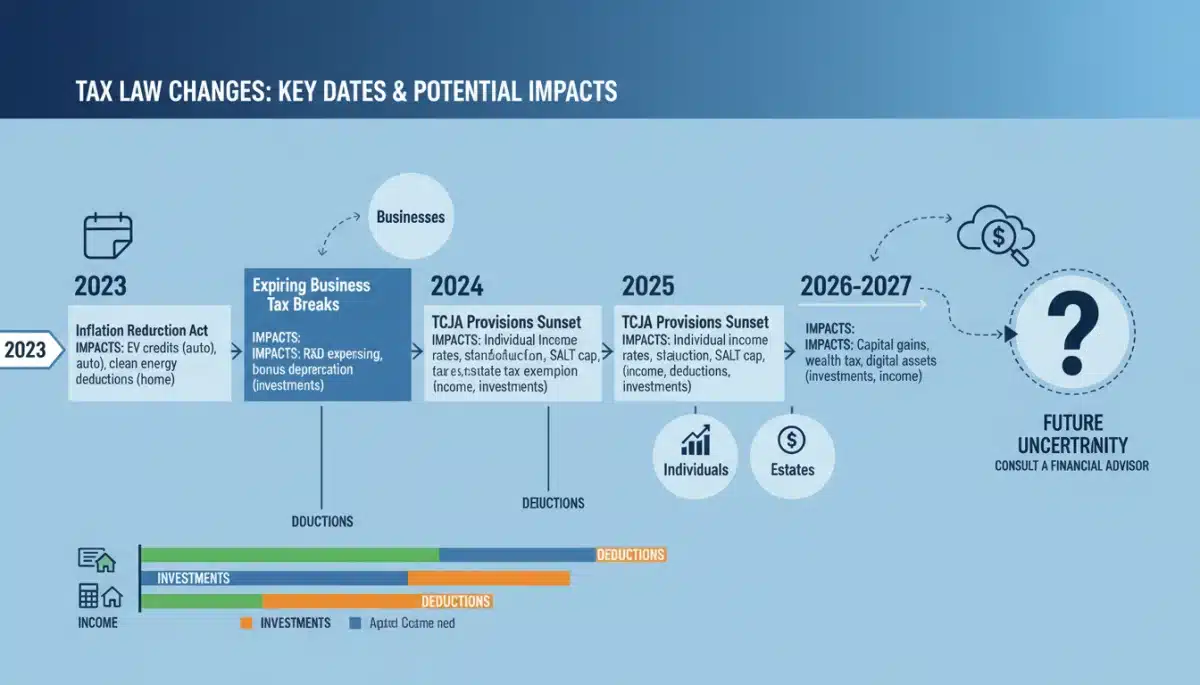
The year 2026 marks a pivotal moment for tax policy in the United States. Several provisions of the Tax Cuts and Jobs Act (TCJA) of 2017 are set to expire, potentially reverting tax laws to their pre-TCJA state. This expiration could have far-reaching implications for individuals and families across various income brackets.
Anúncios
It’s not just about higher taxes; it’s about a complete re-evaluation of how your income, investments, and even your estate are treated under federal law. Being informed is the first step toward effective financial planning. Without a clear understanding, you risk missing opportunities or facing unexpected financial burdens.
Key TCJA Provisions Set to Expire
Several significant changes are on the horizon. These expirations will affect a broad spectrum of taxpayers, from high-net-worth individuals to middle-income families.
- Individual income tax rates are expected to increase across most brackets.
- The standard deduction amounts are likely to decrease substantially.
- Personal exemptions, which were eliminated under TCJA, may return.
- The child tax credit could revert to its previous, lower amount.
The impact of these expirations extends beyond just your annual tax bill. They influence long-term financial strategies, including retirement planning, investment decisions, and charitable giving. Preparing now allows for a smoother transition and helps mitigate potential negative effects on your personal finances.
In essence, the upcoming changes are not merely minor tweaks but a fundamental shift that demands careful attention. Recognizing the scope of these expirations is the foundational step in adapting your financial plan for the coming years.
Revisiting Your Investment Strategy for a New Tax Environment
With potential shifts in capital gains taxes and other investment-related provisions, 2026 could significantly alter the after-tax returns on your portfolio. It’s imperative to re-evaluate your current investment strategy to align with the new tax landscape. This might involve adjusting your asset allocation or considering tax-advantaged accounts more actively.
Ignoring these potential changes could mean leaving money on the table or incurring higher tax liabilities than necessary. A proactive review allows you to optimize your portfolio for efficiency and growth in a potentially higher-tax environment.
Considering Tax-Loss Harvesting and Asset Location
Two strategies that gain prominence in times of tax uncertainty are tax-loss harvesting and strategic asset location. These techniques can help minimize your taxable income and maximize your investment returns.
- Tax-loss harvesting: This involves selling investments at a loss to offset capital gains and potentially a limited amount of ordinary income.
- Asset location: Strategically placing different types of investments in either taxable or tax-advantaged accounts to optimize tax efficiency. For instance, high-growth investments might be better suited for Roth accounts, while bonds could thrive in traditional IRAs.
Furthermore, consider the implications for your long-term growth investments. If capital gains rates increase, holding investments for longer periods to qualify for more favorable long-term capital gains rates becomes even more critical. Consult with a financial advisor to tailor these strategies to your unique financial situation and risk tolerance.
Ultimately, your investment strategy should be dynamic, adapting to both market conditions and legislative changes. By revisiting your approach now, you can position your portfolio for resilience and continued growth even as tax laws evolve.
Optimizing Retirement Planning Ahead of Tax Law Changes
Retirement planning is arguably one of the areas most susceptible to tax law shifts. The expiration of TCJA provisions could impact contribution limits, deduction values, and the taxation of distributions from retirement accounts. Understanding these potential changes is vital for ensuring your retirement savings remain on track.
Many individuals might need to adjust their contribution strategies or even reconsider the types of retirement accounts they prioritize. The goal is to maximize tax benefits now and minimize future tax burdens on your retirement income.
One significant area of focus is the potential return of higher individual income tax rates. If your tax bracket is expected to be higher in the future, maximizing contributions to traditional IRAs or 401(k)s now could provide greater immediate tax deductions. Conversely, if you anticipate being in a higher tax bracket in retirement, Roth conversions or contributions might become more appealing.
Evaluating Roth Conversions and Contribution Limits
The decision to contribute to a traditional or Roth account, or to perform a Roth conversion, hinges heavily on your current and projected future tax brackets. With 2026 on the horizon, these decisions become even more strategic.
- Roth conversions: Converting a traditional IRA to a Roth IRA involves paying taxes now on the converted amount, but future qualified withdrawals are tax-free. This can be advantageous if you expect tax rates to be higher in retirement.
- Contribution limits: Stay informed about potential changes to annual contribution limits for 401(k)s, IRAs, and other retirement vehicles. Maxing out contributions, especially to tax-advantaged accounts, remains a cornerstone of effective retirement planning.
Consider also the impact on required minimum distributions (RMDs) and how they might be affected by future legislation. Engaging with a financial planner specializing in retirement can provide personalized guidance, helping you navigate these complex decisions with confidence.
Ultimately, a robust retirement plan is one that anticipates and adapts to change. By proactively optimizing your strategy for the 2026 tax environment, you can better secure your financial future.
Estate Planning Considerations Amidst Shifting Tax Rules
Estate planning is another critical area that will likely see substantial changes in 2026. The federal estate tax exemption, which was significantly increased under the TCJA, is scheduled to revert to its pre-TCJA levels, adjusted for inflation. This means a much lower exemption amount, potentially subjecting more estates to federal estate taxes.
For individuals with substantial assets, understanding these changes and taking proactive steps is paramount to preserving wealth for future generations. Delaying estate planning updates could lead to significant tax liabilities.
Reviewing Gifting Strategies and Trust Structures
The reduction in the estate tax exemption amount will naturally impact gifting strategies and the effectiveness of existing trust structures. Now is an opportune time to review your current estate plan with legal and financial professionals.
- Annual exclusion gifts: Consider maximizing annual exclusion gifts to reduce the size of your taxable estate. These gifts do not count against your lifetime exemption.
- Irrevocable trusts: Evaluate whether existing irrevocable trusts are still optimal or if new trust structures could better serve your estate planning goals under the new rules. Trusts can offer asset protection and tax advantages.
- Generation-skipping transfer (GST) tax exemption: The GST tax exemption is also tied to the estate tax exemption. Reviewing how you’ve utilized this exemption is crucial, especially if you plan to transfer wealth to grandchildren or later generations.
Furthermore, consider the portability of the deceased spousal unused exclusion (DSUE) amount. While this provision is permanent, its interaction with a reduced exemption amount could become more complex. Updating your will, powers of attorney, and healthcare directives should also be part of a comprehensive estate planning review.
In conclusion, the impending changes to estate tax laws demand immediate attention. Proactive estate planning ensures your legacy is protected and your wishes are honored, minimizing tax burdens on your heirs.
Maximizing Deductions and Credits Before 2026
With the potential reduction in the standard deduction and the reintroduction of personal exemptions, maximizing itemized deductions and available credits in the years leading up to 2026 becomes a strategic imperative. Many taxpayers who currently take the standard deduction might find themselves itemizing again.
Understanding which deductions and credits are most likely to be affected, and how to best utilize them now, can significantly impact your tax liability in the coming years. This requires careful record-keeping and a forward-thinking approach.
Strategies for Itemizing and Utilizing Credits
Even if you currently take the standard deduction, it’s worth tracking potential itemized deductions. Certain expenses, such as state and local taxes (SALT), mortgage interest, and charitable contributions, could become more impactful.
- Bunching deductions: Consider accelerating certain deductible expenses into one year to exceed the standard deduction threshold, then taking the standard deduction in alternate years. This strategy is particularly useful for medical expenses or charitable contributions.
- Health Savings Accounts (HSAs): Maximize contributions to HSAs. These accounts offer a triple tax advantage: tax-deductible contributions, tax-free growth, and tax-free withdrawals for qualified medical expenses.
- Education credits: If you or your dependents are pursuing higher education, ensure you’re taking full advantage of available education credits like the American Opportunity Tax Credit or the Lifetime Learning Credit.
Additionally, be aware of any expiring credits or those that might see changes. For example, some energy-efficient home improvement credits have specific expiration dates or may be modified. Staying abreast of these details can help you plan expenditures to maximize tax benefits.
By proactively reviewing and adjusting your approach to deductions and credits, you can mitigate the impact of potentially less favorable tax laws in 2026 and beyond, keeping more of your hard-earned money.
Consulting a Financial Professional for Personalized Guidance
While understanding the broad strokes of the 2026 tax law changes is essential, the specifics of how these changes will impact your personal finances are unique to your situation. This is where the expertise of a qualified financial professional becomes invaluable. They can provide tailored advice and help you navigate the complexities effectively.
Attempting to interpret and apply all potential tax law changes on your own can be overwhelming and may lead to missed opportunities or costly mistakes. A professional can offer a holistic view of your financial picture.
Choosing the Right Advisor and Asking Key Questions
Selecting a financial advisor who specializes in tax planning and understands the implications of upcoming legislative changes is crucial. Look for someone with relevant certifications and a strong track record.
- Fee structure: Understand how your advisor is compensated (e.g., fee-only, commission-based) to ensure their advice is aligned with your best interests.
- Specialization: Confirm their expertise in tax planning, retirement planning, and estate planning, especially concerning legislative changes.
- Proactive planning: An effective advisor will not just react to changes but help you proactively plan for them, offering strategies that anticipate future scenarios.
When you meet with an advisor, come prepared with key questions. Ask about specific strategies they recommend for your income level, investment portfolio, and family situation in light of the 2026 changes. Inquire about their process for monitoring legislative developments and updating your plan accordingly.
The investment in professional guidance can yield significant returns, both in terms of financial savings and peace of mind. A financial advisor acts as a partner, helping you optimize your financial strategy and adapt to an evolving tax landscape.
| Key Adjustment | Brief Description |
|---|---|
| Review Investments | Adjust portfolio for potential capital gains and tax rate changes. |
| Optimize Retirement | Re-evaluate Roth conversions and contribution strategies. |
| Update Estate Plan | Address changes in federal estate tax exemptions and gifting. |
| Maximize Deductions | Proactively utilize current deductions and credits before changes. |
Frequently Asked Questions About 2026 Tax Changes
The primary changes expected in 2026 involve the expiration of several provisions from the Tax Cuts and Jobs Act of 2017. This includes potential increases in individual income tax rates, decreases in standard deduction amounts, and a reversion of the federal estate tax exemption to lower levels, impacting various aspects of personal finance.
Your investment portfolio could be affected by potential shifts in capital gains tax rates. It’s advisable to review strategies like tax-loss harvesting and asset location. Consider optimizing the placement of different investments in taxable versus tax-advantaged accounts to minimize your overall tax burden and enhance after-tax returns on your investments.
Yes, adjusting retirement contributions is a prudent step. If you anticipate higher tax rates in the future, maximizing traditional IRA or 401(k) contributions now for immediate deductions might be beneficial. Conversely, if you expect higher rates in retirement, Roth contributions or conversions could be more advantageous, ensuring tax-free withdrawals later.
The federal estate tax exemption is expected to significantly decrease, potentially subjecting more estates to taxation. It’s crucial to review your current estate plan, consider maximizing annual exclusion gifts, and evaluate the effectiveness of existing trust structures. Updating your will and other directives is also recommended to align with the new regulations.
While self-education is valuable, consulting a qualified financial professional is highly recommended. They can provide personalized guidance tailored to your specific financial situation, helping you understand the complex implications of the 2026 tax law changes and develop a strategic plan to optimize your financial well-being and mitigate potential risks effectively.
Conclusion
The impending 2026 tax law changes represent a significant juncture for personal finance in the United States. Proactive engagement with these shifts is not merely an option but a necessity for safeguarding and growing your wealth. By understanding the expirations, revisiting your investment and retirement strategies, updating your estate plan, and maximizing current deductions, you can navigate the evolving tax landscape with confidence. Remember, personalized advice from a financial professional can provide invaluable clarity and strategic direction, ensuring your financial decisions are optimized for the challenges and opportunities that lie ahead.