Understanding the 2026 Energy Market: Why Oil Prices Rose 10%
Anúncios
The recent 10% rise in oil prices over the past two months stems from heightened geopolitical tensions, robust global demand, and strategic production adjustments, significantly influencing the 2026 energy market.
Anúncios
The global energy landscape is constantly shifting, and recent developments have once again brought oil prices into sharp focus. Over the past two months, we’ve witnessed a notable 10% surge, prompting questions about the underlying causes and what this means for the future. Understanding the 2026 energy market, especially this recent price hike, requires a deep dive into complex geopolitical, economic, and supply-side factors.
Geopolitical Tensions and Supply Chain Vulnerabilities
Anúncios
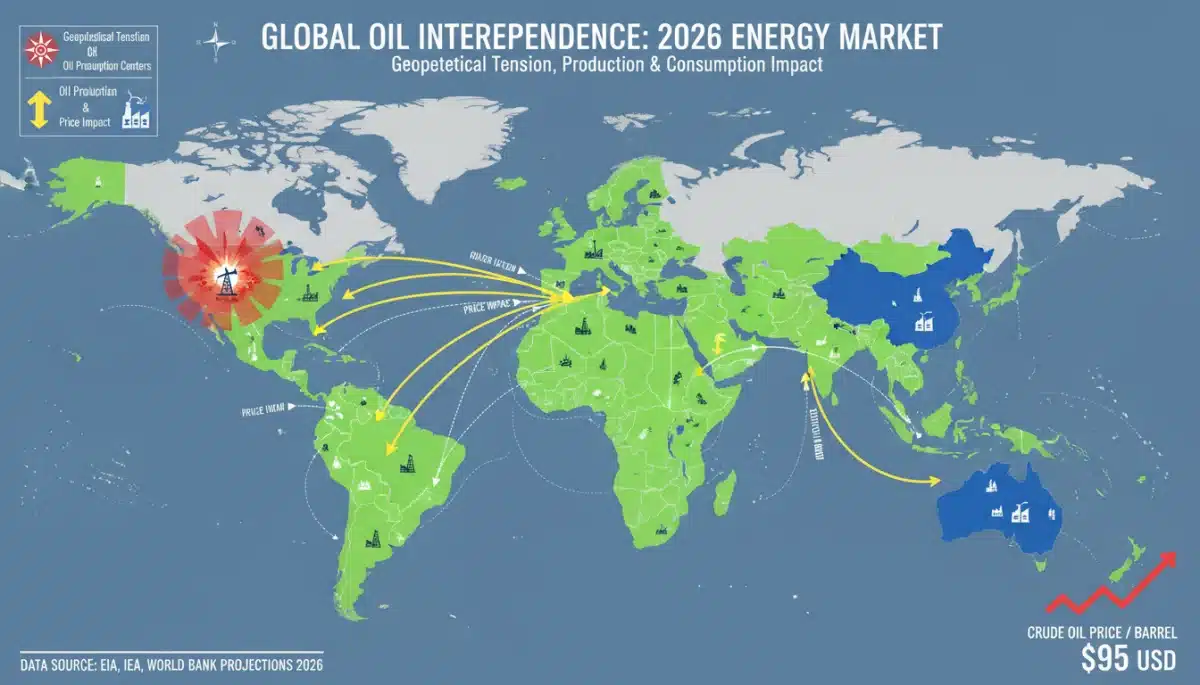
Geopolitical events often act as significant catalysts for oil price fluctuations. Recent escalations in key oil-producing regions and along vital shipping routes have injected considerable uncertainty into the market, directly impacting supply perceptions and actual flows.
The stability of the global oil supply hinges on a delicate balance of international relations and regional security. When this balance is disturbed, even by localized conflicts or political unrest, the market reacts swiftly, pushing prices upward as traders anticipate potential disruptions.
Regional Conflicts and Their Impact
Ongoing conflicts in critical areas, particularly in the Middle East and Eastern Europe, have been instrumental in the recent price increases. These regions are central to global oil production and transit, making any instability there a direct threat to supply. The fear of supply bottlenecks or outright interruptions drives speculative buying, further inflating prices.
- Middle East Volatility: Tensions in the Strait of Hormuz and Red Sea, crucial chokepoints for oil shipments, have increased shipping costs and insurance premiums.
- Eastern European Conflicts: Sanctions and counter-sanctions have reshaped energy trade routes, creating inefficiencies and driving up costs for consumers.
- Political Instability in Producing Nations: Internal strife in certain OPEC+ nations can lead to unexpected production cuts or delays, reducing global supply.
In essence, the heightened geopolitical risk premium is a substantial component of the recent 10% rise. Market participants are factoring in the increased probability of supply shocks, leading to higher prices as a hedge against future scarcity.
Global Demand Resurgence and Economic Recovery
Beyond supply-side shocks, a robust resurgence in global demand has also played a crucial role in the upward trend of oil prices. As major economies continue to recover from recent downturns, industrial activity and transportation needs have steadily increased, translating into higher energy consumption.
The post-pandemic recovery, though uneven, has seen many sectors rebound strongly. This renewed economic vigor, particularly in large consumer nations, has created a demand-side pressure that, when combined with supply constraints, inevitably pushes prices higher.
Key Economic Drivers
Several economic indicators point to sustained demand growth. Manufacturing output, air travel, and freight transport have all shown significant recovery, each contributing to the overall increase in oil consumption. This broad-based recovery suggests that the demand for oil is not merely a temporary spike but rather a reflection of underlying economic strength.
- Industrial Growth: Factories are running at higher capacities, requiring more crude oil for power generation and as feedstock for petrochemicals.
- Increased Mobility: Air travel has largely recovered, and road transportation continues to grow, boosting demand for jet fuel and gasoline.
- Emerging Market Expansion: Rapid urbanization and industrialization in developing economies are driving long-term energy demand trends.
The sustained global economic recovery is a fundamental factor underpinning the recent oil price increase. As economies grow, so does their appetite for energy, creating a strong floor for prices and contributing to the upward momentum observed in the last two months.
OPEC+ Production Policies and Strategic Reserves
The decisions made by the Organization of the Petroleum Exporting Countries and its allies (OPEC+) are paramount in shaping the global oil supply. Their collective production policies, often influenced by geopolitical considerations and market forecasts, directly impact the availability of crude oil and, consequently, its price.
In the face of fluctuating demand and geopolitical uncertainties, OPEC+ has often adopted a cautious approach to production increases, prioritizing market stability and price support over aggressive market share expansion. This strategy has been a significant factor in balancing supply with demand, especially during periods of geopolitical tension.
Balancing Supply and Demand
OPEC+ meetings and their subsequent announcements are closely watched by market analysts. Recent decisions to maintain or only modestly increase production have signaled a desire to keep the market relatively tight, preventing a glut that could depress prices. This controlled supply environment helps explain part of the recent 10% price jump.
- Production Cuts: Past and ongoing production cuts by OPEC+ members have reduced overall supply, creating a leaner market.
- Cautious Incremental Increases: Rather than flooding the market, OPEC+ has opted for measured, incremental production increases, ensuring demand can absorb the new supply.
- Strategic Reserve Management: While not directly controlled by OPEC+, the drawdown and replenishment of strategic petroleum reserves by major consuming nations also influence market dynamics and price perceptions.
The disciplined approach of OPEC+ in managing global oil supply, coupled with the strategic reserve policies of key nations, plays a critical role in the current high-price environment. Their collective actions effectively limit supply growth, contributing to the upward pressure on prices observed recently.
Investment Trends and Speculative Trading
The financial markets and the behavior of investors also significantly influence oil prices. Commodity trading, driven by both fundamental analysis and speculative sentiment, can amplify price movements, especially during periods of uncertainty. The perception of future scarcity or abundance often dictates investment flows, leading to rapid price shifts.
Large institutional investors, hedge funds, and individual traders continuously assess market conditions, economic forecasts, and geopolitical developments. Their collective decisions to buy or sell oil futures contracts can create powerful momentum, either upward or downward, irrespective of immediate physical supply and demand.
The Role of Financial Markets
In recent months, increased speculative activity, fueled by the aforementioned geopolitical tensions and strong demand forecasts, has contributed to the upward price trajectory. Traders betting on continued price appreciation have pushed futures contracts higher, creating a feedback loop that reinforces the upward trend.
- Futures Market Activity: High trading volumes in oil futures indicate strong investor interest and expectations of continued price increases.
- Inflation Hedges: In an environment of rising inflation, investors often turn to commodities like oil as a hedge, further boosting demand in financial markets.
- Algorithmic Trading: Automated trading systems, reacting to news and market signals, can exacerbate price movements, creating rapid swings.
The financialization of the oil market means that investment trends and speculative trading are integral to understanding price movements. The recent 10% rise is partly a reflection of strong investor confidence in sustained demand and concerns over future supply, leading to significant capital inflows into oil-related assets.
The Energy Transition and Underinvestment in Production
The ongoing global energy transition, aimed at shifting away from fossil fuels towards renewable sources, has an interesting and sometimes counterintuitive impact on the oil market. While the long-term goal is reduced reliance on oil, the transition itself has led to underinvestment in traditional oil and gas production, creating supply constraints in the short to medium term.
Many major oil companies and investors are reallocating capital away from new exploration and production projects, prioritizing renewable energy initiatives. This shift, while vital for combating climate change, means that the existing oil infrastructure is aging, and new supplies are not coming online at the pace needed to meet current demand.
Long-Term Structural Shifts
The paradox of the energy transition is that as the world seeks to reduce its dependence on oil, the underinvestment in new production can inadvertently lead to higher prices for the oil that is still needed. This structural shift is a critical, albeit less immediate, factor contributing to the current market tightness and the recent price surge.
- Reduced Capital Expenditure: Major oil companies are cutting back on investments in new upstream projects, limiting future supply growth.
- Aging Infrastructure: Existing oil fields are experiencing natural decline rates, and without new investment, global production capacity can diminish.
- Policy Uncertainty: Shifting government policies and environmental regulations create uncertainty for long-term oil projects, deterring investment.
The energy transition’s unintended consequence of underinvestment in conventional oil production is a significant, structural factor contributing to the current market dynamics. As the world still heavily relies on oil, a constrained supply pipeline due to this underinvestment inevitably leads to upward price pressure, playing a part in the recent 10% increase.
Inflationary Pressures and Currency Devaluation
Global inflationary pressures and, in some instances, currency devaluation also contribute to the perceived rise in oil prices. Since oil is typically priced in U.S. dollars, a weakening of the dollar against other major currencies can make oil cheaper for countries holding those currencies, thereby increasing demand. Conversely, strong inflation can lead to higher nominal prices for all commodities, including oil.
The purchasing power of currencies directly influences how expensive oil appears to different nations. When the U.S. dollar weakens, oil becomes more affordable for buyers using other currencies, stimulating demand and pushing up prices in dollar terms. Simultaneously, broad-based inflation means that the cost of producing and transporting oil also increases, necessitating higher selling prices.
Economic Fundamentals at Play
Central bank policies, interest rate decisions, and government spending all impact currency valuations and inflationary trends. These macroeconomic factors create a complex environment where the price of oil is not just a reflection of supply and demand for the commodity itself, but also a function of broader economic conditions.
- Dollar Fluctuations: A weaker U.S. dollar makes oil relatively cheaper for non-dollar denominated buyers, increasing demand.
- Global Inflation: Rising input costs for oil production, from labor to equipment, contribute to higher break-even prices for producers.
- Monetary Policy: Loose monetary policies can inject liquidity into the financial system, potentially fueling commodity speculation and inflation.
The interplay of inflationary pressures and currency dynamics adds another layer of complexity to oil price analysis. These macroeconomic forces can independently drive up nominal oil prices, making the recent 10% increase a multifaceted phenomenon influenced by both direct market factors and broader economic trends.
| Key Factor | Brief Description |
|---|---|
| Geopolitical Tensions | Conflicts in key regions disrupt supply, increasing risk premiums and prices. |
| Global Demand Growth | Economic recovery and industrial rebound boost consumption, creating upward price pressure. |
| OPEC+ Policies | Controlled production increases by major producers maintain a tight market. |
| Underinvestment | Energy transition leads to reduced capital in new oil production, constraining future supply. |
Frequently Asked Questions About the 2026 Energy Market
The recent 10% oil price hike is primarily driven by escalating geopolitical tensions in key producing regions, a robust resurgence in global economic demand, and strategic production adjustments by OPEC+ nations, all contributing to a tighter supply-demand balance.
Geopolitical events, such as conflicts or political instability in major oil-producing regions or critical shipping lanes, introduce supply uncertainty. This leads to increased risk premiums, speculative buying, and potential disruptions, directly pushing oil prices higher.
Yes, the global economic recovery is a significant factor. Increased industrial activity, higher transportation needs, and a rebound in sectors like air travel all contribute to a stronger demand for crude oil, creating upward pressure on prices.
OPEC+ plays a crucial role by setting collective production policies. Their decisions to maintain or cautiously increase output directly influence global supply levels. By controlling supply, they aim to stabilize the market and support prices, as seen in recent months.
The energy transition, while long-term, currently leads to underinvestment in new oil and gas exploration and production. This reduces future supply capacity, and combined with ongoing demand, creates a tighter market and contributes to higher prices in the short to medium term.
Conclusion
The recent 10% surge in oil prices over the past two months is not a singular event but rather the culmination of several interconnected global forces. From the volatile landscape of geopolitics and the strategic decisions of OPEC+ to the robust resurgence in global demand and the structural shifts brought about by the energy transition, each factor plays a vital role in shaping the 2026 energy market. Understanding these dynamics is crucial for businesses, policymakers, and consumers alike, as they collectively dictate the future trajectory of energy costs and the broader economic environment.