Future of Work 2026: Automation’s Impact on US Jobs
Anúncios
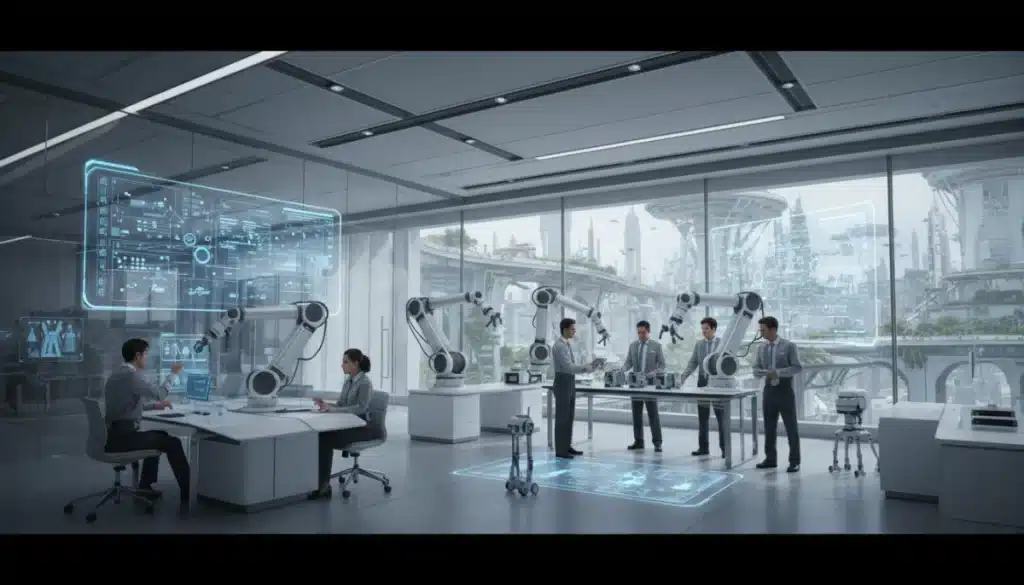
By 2026, automation is projected to significantly reshape the U.S. labor landscape, potentially displacing 5% of jobs while simultaneously fostering new roles and demanding evolving skill sets from the workforce.
Anúncios
The landscape of employment is undergoing a profound transformation, and understanding the future of work automation is critical for individuals and businesses alike. As we approach 2026, projections indicate that automation is poised to displace a significant portion of U.S. jobs, demanding a proactive approach to adaptation and skill development. This article delves into the nuances of this shift, exploring both the challenges and opportunities that lie ahead.
Anúncios
Understanding the Automation Wave and Job Displacement
The rise of automation is not a new phenomenon, but its acceleration in recent years has brought it to the forefront of economic discussions. This section explores the fundamental drivers behind the automation wave and the specific mechanisms through which it is expected to impact U.S. employment figures by 2026.
Automation, driven by advancements in artificial intelligence, robotics, and machine learning, is increasingly capable of performing tasks once exclusive to human workers. This isn’t just about factory floors; it extends to administrative roles, customer service, and even aspects of creative industries. The projected 5% displacement of U.S. jobs by the decade’s end represents a significant shift, affecting millions of livelihoods.
Key drivers of increased automation adoption
- Technological advancements: Rapid improvements in AI and robotics make automation more accessible and efficient.
- Cost reduction: Automated systems can often operate 24/7 without breaks, leading to lower operational costs.
- Increased efficiency and accuracy: Machines can perform repetitive tasks with greater speed and fewer errors than humans.
- Pandemic acceleration: The COVID-19 pandemic highlighted the need for resilient operations, pushing many businesses towards automation to reduce reliance on human labor in certain contexts.
The impact of this displacement is not evenly distributed across all sectors or demographic groups. While some roles will be entirely automated, others will be augmented, meaning human workers will collaborate with automated systems. Understanding these nuances is crucial for crafting effective strategies to navigate the evolving job market.
In conclusion, the automation wave is a powerful force, driven by technological progress and economic imperatives. Its influence on job displacement by 2026 is a complex issue that requires careful consideration of both the macro-economic trends and the micro-level impacts on individual careers.
Sectors Most Vulnerable to Automation by 2026
As automation continues its march forward, certain sectors of the U.S. economy are more susceptible to significant job displacement than others. Identifying these vulnerable areas is essential for both policymakers and workers to prepare for the impending changes and mitigate potential negative outcomes.
Roles characterized by repetitive, predictable tasks with clear rules are prime candidates for automation. This includes a wide array of jobs from manufacturing to administrative support and even parts of the service industry. The goal for businesses is often to increase efficiency and reduce labor costs, making automation an attractive solution.
High-risk industries and job functions
- Manufacturing and Production: Assembly line workers, machine operators, and quality control specialists are increasingly being replaced by advanced robotics.
- Transportation and Logistics: Truck drivers, delivery personnel, and warehouse workers face threats from autonomous vehicles and automated sorting systems.
- Administrative and Office Support: Data entry clerks, receptionists, and certain accounting roles can be automated through AI-powered software and virtual assistants.
- Customer Service: Chatbots and AI-driven call centers are handling a growing number of customer inquiries, reducing the need for human agents.
It’s important to note that while these sectors face significant challenges, automation also creates new roles within them, particularly in the areas of maintenance, programming, and oversight of automated systems. However, the net effect in the short term is expected to be a reduction in overall employment within these specific functions.
Ultimately, understanding which sectors are most vulnerable allows for targeted intervention and support programs. This foresight can help communities and individuals adapt to the changing economic landscape rather than being caught unprepared by the rapid pace of technological evolution.
Emerging Job Opportunities and the New Skill Landscape
While automation undeniably presents challenges through job displacement, it simultaneously acts as a powerful catalyst for the creation of new roles and the evolution of existing ones. This section explores the burgeoning job opportunities that arise from an increasingly automated economy and the essential skills required to thrive in this new environment.
The narrative around automation often focuses solely on job loss, but a more comprehensive view reveals a dynamic shift in the types of work available. As machines take over routine tasks, human creativity, critical thinking, emotional intelligence, and complex problem-solving become even more valuable. These are the uniquely human attributes that automation struggles to replicate.
In-demand skills for the automated future
- Digital Literacy and Tech Proficiency: Understanding how to interact with and manage automated systems, data analysis tools, and AI platforms.
- Critical Thinking and Problem-Solving: The ability to analyze complex situations, identify root causes, and devise innovative solutions.
- Creativity and Innovation: Developing new ideas, products, and services that machines cannot yet conceive.
- Emotional Intelligence and Collaboration: Working effectively with diverse teams, understanding human needs, and navigating interpersonal dynamics.
- Adaptability and Lifelong Learning: The willingness and capacity to continuously acquire new skills and adjust to changing job requirements.
Beyond these core competencies, new specialized roles are emerging. Think of AI trainers, robotics engineers, data ethicists, and human-machine interaction designers. These positions require a blend of technical expertise and soft skills, highlighting the need for a multidisciplinary approach to education and workforce development.
In essence, the future of work is not about humans competing with machines, but rather about humans collaborating with them, leveraging our distinct capabilities. This necessitates a significant investment in education and training to equip the workforce with the skills needed to seize these new opportunities.
The Role of Education and Reskilling in a Changing Economy
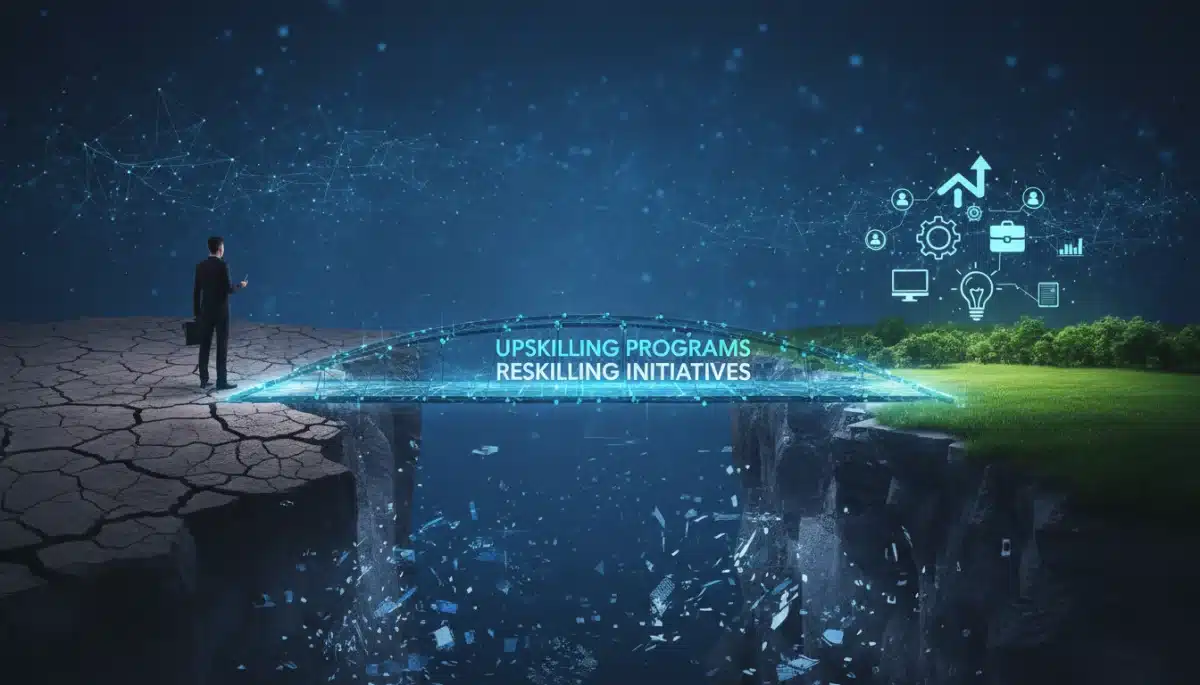
As the U.S. job market grapples with the impact of automation, the imperative for robust education and reskilling initiatives becomes paramount. This section highlights the critical role these programs play in preparing the workforce for the jobs of tomorrow and mitigating the social and economic disruptions caused by technological change.
Traditional educational pathways may no longer be sufficient in an era of rapid technological evolution. Lifelong learning is transforming from a desirable trait into an absolute necessity. Both individuals and institutions must embrace a continuous learning mindset to remain relevant and competitive in the evolving labor landscape.
Strategies for effective workforce adaptation
- Government-funded training programs: Investing in initiatives that provide accessible and affordable training for in-demand skills.
- Employer-led upskilling: Companies taking responsibility for training their existing workforce to adapt to new technologies and roles.
- Community college and vocational school expansion: Strengthening institutions that offer practical, skills-based education aligned with industry needs.
- Online learning platforms: Leveraging digital resources to provide flexible and scalable learning opportunities for a diverse population.
Reskilling isn’t just about learning new technical skills; it also encompasses fostering adaptability, critical thinking, and problem-solving abilities. These ‘soft skills’ are increasingly recognized as crucial for navigating uncertainty and collaborating effectively with automated systems.
The success of these educational and reskilling efforts will largely determine how smoothly the U.S. transitions into an automated future. A proactive and comprehensive approach can transform potential job displacement into an opportunity for economic growth and individual empowerment.
Policy Responses and Societal Implications of Automation
The scale of job transformation predicted by 2026 demands thoughtful policy responses and a deep understanding of the broader societal implications. This section examines how governments and communities can proactively address the challenges and harness the benefits of widespread automation.
Ignoring the potential for significant job displacement could lead to increased economic inequality and social unrest. Therefore, policymakers are exploring various strategies, from adjusting social safety nets to incentivizing businesses to invest in human capital alongside automation.
Potential policy interventions and societal considerations
- Universal Basic Income (UBI) discussions: Exploring whether a guaranteed income could provide a safety net for those displaced by automation.
- “Robot tax” proposals: Debating the taxation of automated systems to fund retraining programs or social welfare.
- Investment in infrastructure: Ensuring that digital infrastructure supports the new economy, including broadband access for remote work and online learning.
- Ethical AI development: Establishing guidelines and regulations for the responsible development and deployment of AI to prevent biases and ensure fairness.
Beyond economic policies, automation also raises fundamental questions about the nature of work, leisure, and human purpose. As repetitive tasks are automated, society may need to reconsider traditional notions of employment and value creation. This could lead to a re-emphasis on creative pursuits, community engagement, and personal development.
Addressing these complex issues requires a multi-stakeholder approach, involving governments, businesses, educational institutions, and civil society. Collaborative efforts are essential to ensure that the benefits of automation are widely shared and that the transition is as equitable as possible for all Americans.
Preparing for the Automated Workforce: Strategies for Individuals and Businesses
With the future of work automation rapidly approaching, both individuals and businesses must adopt proactive strategies to navigate the impending changes. This section outlines actionable steps that can be taken to prepare for a workforce where automation plays an increasingly central role.
For individuals, the focus must be on continuous learning and skill adaptation. The traditional career path, where one set of skills lasts a lifetime, is largely obsolete. Instead, a mindset of perpetual growth and flexibility will be key to long-term career resilience.
Individual strategies for career resilience
- Embrace lifelong learning: Actively seek out courses, certifications, and online resources to acquire new skills, especially in digital and analytical fields.
- Develop ‘human’ skills: Strengthen critical thinking, creativity, emotional intelligence, communication, and collaboration abilities.
- Network strategically: Build connections with professionals in emerging industries and roles to stay informed about opportunities.
- Consider alternative career paths: Be open to pivoting to new industries or roles that are less susceptible to automation or are newly created by it.
For businesses, preparing for the automated workforce involves more than just implementing new technologies. It requires a fundamental rethinking of organizational structures, talent management, and corporate culture. Investing in employees’ growth is not just a moral imperative but a strategic business advantage.
Business strategies for a future-ready workforce
- Invest in employee upskilling and reskilling: Provide training programs that equip current employees with the skills needed for new, automation-driven roles.
- Foster a culture of continuous learning: Encourage and support employees in their pursuit of new knowledge and adaptability.
- Redesign job roles: Focus on augmenting human capabilities with automation, creating hybrid roles that leverage the strengths of both.
- Prioritize ethical AI implementation: Ensure that automation is deployed responsibly, considering its impact on employees and society.
By taking these proactive steps, both individuals and businesses can not only mitigate the risks associated with automation but also unlock new opportunities for growth, innovation, and a more fulfilling work experience in the years leading up to and beyond 2026.
| Key Aspect | Brief Description |
|---|---|
| Job Displacement | Automation is projected to displace 5% of U.S. jobs by 2026, particularly in repetitive task-oriented roles. |
| Emerging Opportunities | New roles requiring digital literacy, critical thinking, and creativity are expected to grow significantly. |
| Reskilling Imperative | Education and continuous reskilling are crucial for individuals and businesses to adapt to the new workforce demands. |
| Policy & Ethics | Governments and organizations must develop policies and ethical guidelines for responsible automation implementation. |
Frequently Asked Questions About Automation and Work
Current projections suggest that approximately 5% of U.S. jobs could be displaced by automation by the end of the decade. This displacement primarily targets roles involving repetitive, predictable tasks that machines can perform more efficiently and accurately.
Sectors most vulnerable to automation include manufacturing, transportation and logistics, administrative and office support, and parts of customer service. Jobs within these areas often involve routine tasks that are easily codified and executed by automated systems or AI.
Automation is expected to create new roles in areas like AI development, robotics engineering, data science, cybersecurity, and human-machine interaction design. It also elevates the importance of uniquely human skills such as creativity, critical thinking, and emotional intelligence in all professions.
Individuals can prepare by embracing lifelong learning, focusing on digital literacy, and developing strong ‘human’ skills like critical thinking, creativity, and adaptability. Engaging in reskilling programs and networking within emerging industries are also crucial steps for career resilience.
Governments should invest in training programs, consider social safety nets, and establish ethical AI guidelines. Businesses must prioritize upskilling their workforce, redesigning job roles to augment human capabilities, and fostering a culture of continuous learning and responsible automation deployment.
Conclusion
The journey towards 2026 will undoubtedly be marked by significant shifts in the U.S. labor market, with automation playing a pivotal role. While the projected displacement of 5% of jobs presents considerable challenges, it also underscores a powerful opportunity for growth and innovation. By proactively investing in education, fostering adaptability, and implementing thoughtful policies, individuals, businesses, and governments can collectively navigate this transformation. The future of work is not merely about adapting to technology, but about consciously shaping a workforce that is resilient, skilled, and ready to thrive in an increasingly automated world, ensuring that the benefits of progress are shared broadly across society.